Flatbed Truck Accident Settlement: Falling-Cargo Claims
Flatbed crashes often start with cargo that shifts or falls off. That triggers FMCSA securement rules and adds defendants beyond the driver. Here's how it works.
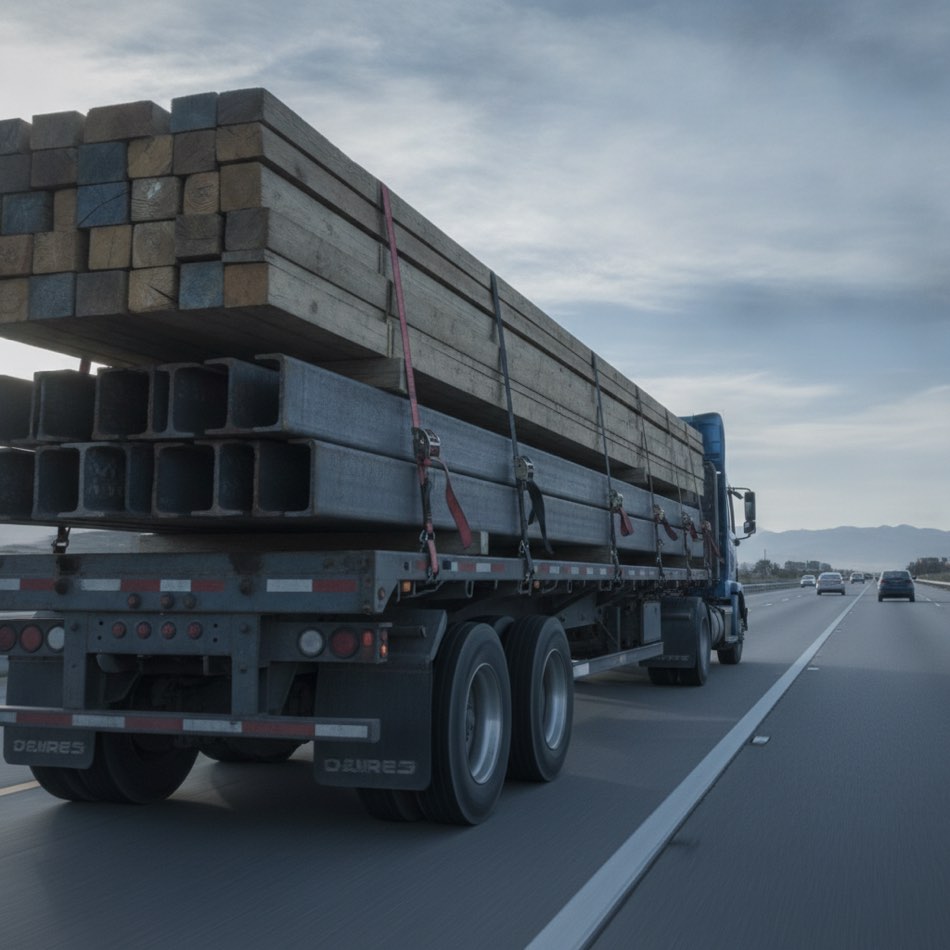
A flatbed isn’t an enclosed trailer — its cargo (steel coils, lumber, pipe, machinery) rides out in the open, held down only by chains, straps, and binders. So the signature flatbed crash isn’t a rear-end or a jackknife. It’s cargo that shifts or falls off and strikes other vehicles. That single fact reshapes a flatbed truck accident settlement: it pulls in federal cargo-securement rules and adds defendants beyond the driver.
This article is for people hurt in a crash involving a flatbed or its falling load. It is educational, not legal advice — for your specific case, talk to a licensed attorney in your state.
Why flatbed settlements are different
In a typical truck crash, the fight is about how the truck moved. In a flatbed falling-cargo case, the fight is about how the load was secured — and that opens a wider liability picture. A chain doesn’t snap or a coil doesn’t roll off by accident. Somebody chose the tiedowns, did the math on whether they were strong enough, and either blocked the cargo against movement or didn’t.
That means a flatbed case can reach people who never touched the steering wheel: the company that loaded and secured the cargo, the shipper who handed it over, and sometimes a separate loading contractor. More potentially-liable parties can mean more available insurance coverage, which is one reason these cases are evaluated differently from a standard car-vs-truck collision.
Who may be liable when cargo falls off a flatbed
Liability in a securement-failure case is rarely just “the driver.” Here’s who can be on the hook and why:
| Potential defendant | Why they may be liable |
|---|---|
| Truck driver | The driver is responsible for inspecting cargo and securement before and during the trip under FMCSA rules |
| Motor carrier (trucking company) | Responsible for the driver, training, equipment, and ensuring loads comply with securement rules |
| The party that loaded/secured the cargo | If a warehouse, terminal, or crew loaded and strapped the freight, a securement failure points to them |
| Shipper | May be liable where it controlled loading or concealed the cargo’s true weight or characteristics |
| Separate loading contractor | A third-party loading company hired to load/secure can be a distinct defendant |
| Equipment maker | If a chain, binder, strap, or anchor point failed below its rating, a product claim may exist |
Who actually loaded and secured the freight is a fact question — the securement records usually answer it.
The FMCSA cargo-securement rules a flatbed case turns on
Federal cargo-securement standards live in 49 CFR Part 393, Subpart I (“Protection Against Shifting and Falling Cargo”). A few provisions do most of the work in a falling-cargo claim:
- Performance standard (§ 393.102). Securement systems must be able to withstand the forces of normal driving without the cargo shifting or falling — specifically a deceleration of 0.8 g forward, and acceleration of 0.5 g rearward and 0.5 g laterally. If a load came off under ordinary braking or a routine turn, the securement didn’t meet the standard.
- Working load limit (WLL). Every tiedown has a working load limit — the maximum load it’s rated to handle. The aggregate WLL of all the tiedowns must be at least one-half (50%) the weight of the cargo they secure. This is the “working-load-limit math” at the heart of these cases.
- Minimum number of tiedowns (§ 393.110). When cargo isn’t blocked or braced against movement, the rule sets a floor: one tiedown for an article 5 feet or less and 1,100 pounds or less; two tiedowns for longer or heavier articles; and one more tiedown for every additional 10 feet of length.
- Blocking and bracing. Cargo must be firmly immobilized — by structures, dunnage, shoring bars, tiedowns, or a combination — so it can’t shift or roll.
Source: U.S. DOT Federal Motor Carrier Safety Administration, Cargo Securement Rules, implementing 49 CFR Part 393, Subpart I. There are also commodity-specific rules for high-risk flatbed loads — logs, metal coils, large boulders, and similar — layered on top of the general rules.
The evidence that decides a falling-cargo case
Because the question is “was the load secured to federal standard,” these cases hinge on records, not just witness memory:
- Securement records and load documents. What was hauled, what it weighed, and how it was strapped or chained.
- The tiedowns themselves. Their type, condition, and marked working load limit — so the 50% math can be checked against the cargo weight.
- Driver inspection logs. FMCSA requires the driver to inspect cargo and securement and re-check it during the trip; gaps in those logs matter.
- Photos of the scene and the failed securement. A snapped chain, a missing binder, or too few straps tells the story.
- The loading chain. Who loaded, who secured, and who controlled the process — this is what separates one defendant from another.
Preserving this evidence early is critical, which is why falling-cargo claims often move faster on the investigation side than a routine collision. For how securement failures fit the broader pattern of regulatory violations, see our guide on FMCSA violations in truck accidents.
How this shapes the settlement value
A flatbed falling-cargo settlement is built from the same core components as any truck case — medical bills, lost income, pain and suffering — but two features tend to push these cases:
- Severity. Loose steel, lumber, or pipe striking a passenger vehicle, or debris in the travel lane, tends to cause serious injuries. Higher damages are the single biggest driver of settlement size.
- More defendants, more coverage. When the carrier, the loader, and the shipper are all potentially liable, there can be multiple insurance policies in play, which can affect what’s recoverable.
A clear securement violation — too few tiedowns, an under-rated chain, no blocking — strengthens the liability side of the equation. But every case turns on its own facts and injuries; there’s no fixed multiplier. To understand the mechanics, see how truck accident settlements are calculated and the ranges in our average truck accident settlement guide.
Estimate your settlement range
Before anything else, it helps to know the ballpark you’re working with. Our free settlement calculator gives a state-specific estimate in about 60 seconds — no email required — based on your medical costs, lost income, and injury severity.
Frequently asked questions
Who is liable if cargo falls off a flatbed and hits my car?
Potentially several parties: the driver, the trucking company, and whoever loaded and secured the cargo — which can be a warehouse, terminal, shipper, or a separate loading contractor. A securement failure under 49 CFR Part 393 points to whoever was responsible for strapping and inspecting the load.
What is the working load limit, and why does it matter?
The working load limit (WLL) is the maximum load a tiedown is rated to handle. Under FMCSA rules, the combined WLL of all tiedowns must be at least 50% of the cargo’s weight. If the math shows the straps or chains were under-rated for the load, that’s strong evidence the securement violated federal standards.
What FMCSA rules apply to flatbed cargo?
Cargo securement is governed by 49 CFR Part 393, Subpart I. Key pieces are the performance standard (§ 393.102), the working-load-limit and 50% aggregate rule, the minimum-tiedown counts (§ 393.110), and blocking-and-bracing requirements — plus commodity-specific rules for loads like logs and metal coils.
Does a securement violation guarantee a bigger settlement?
No — but it helps the liability side. A documented violation (too few tiedowns, an under-rated chain, no blocking) makes fault clearer and can add defendants. Settlement value still depends mostly on injury severity and economic losses, which vary case to case.
What evidence should be preserved after a falling-cargo crash?
Securement records, load and weight documents, the tiedowns and their working-load-limit markings, the driver’s cargo-inspection logs, and photos of the scene and any failed chains or straps. This evidence can disappear quickly, so it’s worth flagging early.
The bottom line
A flatbed truck accident settlement often comes down to one question: was the load secured to the federal standard? Because the cargo rides in the open, a shift or fall implicates 49 CFR Part 393, Subpart I — the working-load-limit math, the minimum tiedowns, the blocking and bracing — and pulls in defendants beyond the driver: the carrier, the loader, the shipper. The securement records usually decide it. Start by estimating your range with the free settlement calculator, then check your state’s truck accident rules.
This article is for educational purposes only and is not legal advice. Liability and settlement value depend on the specific facts of your case and the law in your state. Consult a licensed attorney in your jurisdiction.