Tow Truck Accident Settlement: Who Pays and How Much
Tow truck crashes create unusual liability — the operator, the towing company, or whoever called the tow. Here's how fault and insurance work in a settlement.
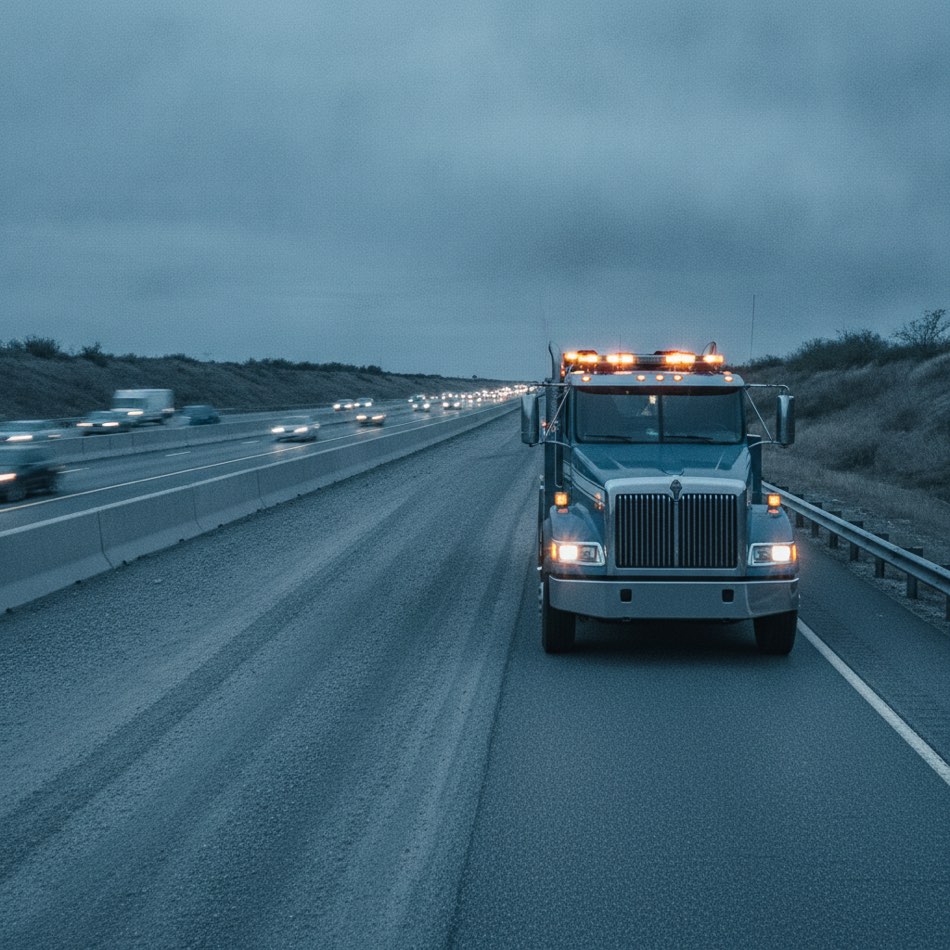
A tow truck accident settlement is shaped less by the size of the crash and more by who was at fault and which insurance policy responds. Tow trucks create liability situations you don’t see in ordinary truck wrecks — a load coming loose, an operator struck on the shoulder, or a predatory tower with thin coverage. This guide explains who pays and why.
This article is for people injured in or around a tow truck in the U.S. who want to understand how fault and insurance drive a settlement. It is educational, not legal advice — for your specific case, talk to a licensed attorney in your state.
What makes tow truck settlements different
Most truck accident claims are simple in structure: a commercial truck hits you, the carrier’s liability policy pays. Tow trucks break that pattern in three ways.
First, the equipment varies enormously. A light-duty wheel-lift or flatbed handling a sedan is a different machine — and a different insurance risk — than a heavy-duty rotator recovering an overturned semi. The heavier the rig and the bigger the job, the more insurance is usually in play.
Second, a tow truck is often at the scene of someone else’s accident. The operator is parked on a busy shoulder, working in live traffic, exposed to “struck-by” risk. That introduces move-over laws and a third driver who may be the one truly at fault.
Third, the towed vehicle is part of the system. If a car comes loose, or its weight causes the tow truck to lose control, the crash flows from how the load was secured — which points liability straight at the operator and company.
Who is liable in a tow truck accident? (scenario table)
Liability depends entirely on what kind of tow truck incident happened. Here are the common scenarios and who typically answers for them.
| Scenario | Who is typically liable | Insurance that may respond |
|---|---|---|
| Tow truck crashes into you while driving | Tow operator + towing company | Commercial auto liability |
| Towed vehicle comes loose and causes a crash | Operator/company (improper securement) | Commercial auto liability; on-hook for the towed car |
| You’re struck while your car is being towed/loaded | Operator/company, or a passing driver who failed to move over | Commercial auto liability and/or the other driver’s policy |
| Tow operator struck on the shoulder by a passing car | The passing driver (move-over violation) | The passing driver’s liability policy |
| Your vehicle damaged during the tow | Towing company | On-hook (towed-vehicle) coverage |
| Predatory / non-consensual tow with thin insurance | Operator/company; possibly whoever ordered the tow | Whatever policy exists; possibly your own UM/UIM |
| Police- or property-ordered tow goes wrong | Operator/company; the ordering party rarely liable | Commercial auto liability |
General framework only; fault is decided on the facts of each case and your state’s law.
The three liability situations in detail
1. Crashes while towing. When a tow truck is hauling a vehicle and something goes wrong, the question is usually securement and control. If the towed car wasn’t properly chained or strapped and it breaks free, that’s a securement failure by the operator. If the combined weight made the truck hard to stop or steer and it rear-ended you, that again points at the operator and the company that put an under-equipped rig on the job. These are the cleanest cases for establishing fault against the towing business.
2. Operators working a roadside scene. Tow operators are among the most exposed workers on the highway. According to AAA-cited data reported by the Colorado Department of Transportation, roughly one in three drivers ignore roadside safety laws, and surveillance footage showed only about 58% of drivers slowed or moved over for a stopped tow truck. When a passing driver clips an operator — or clips you while your car is being loaded — the at-fault party is usually that passing driver, not the towing company.
3. Predatory and non-consensual towing. Some operators who do non-consensual tows (illegal-parking grabs, accident “chasing”) carry only the bare minimum insurance. If one of them injures you, the available coverage may be thin. That’s where your own uninsured/underinsured motorist (UM/UIM) coverage can matter, and why identifying every possible policy early is important.
How tow truck insurance shapes your settlement
The money in a settlement comes from policies, so it helps to know which ones exist.
- Commercial auto liability is the primary policy for injuries the tow truck causes to other people. Tow companies that operate across state lines under FMCSA authority generally must carry at least $750,000 in liability coverage, per FMCSA financial-responsibility rules. Purely local towers that don’t cross state lines may not be subject to FMCSA filings and can carry lower state-mandated limits — one reason local, non-consensual operators sometimes have thin coverage.
- On-hook (towed-vehicle) coverage pays for damage to the specific vehicle hooked to the truck while it’s in the towing company’s care. As insurance educators like East Insurance Group explain, standard commercial auto liability covers damage the tow truck causes to others, not damage to the car it’s hauling — that’s what on-hook is for.
- UM/UIM is your own coverage and becomes critical when the tower is uninsured or carries too little.
Because limits vary so much between a small local outfit and a large interstate recovery company, the realistic value of a claim often depends on which business — and which policy — is on the hook. For the broader picture of how trucking policies stack up, see our guide to commercial truck insurance explained.
What drives the dollar amount
Once liability and coverage are clear, the value of a tow truck settlement is built the same way as any injury claim: your economic damages (medical bills, future treatment, lost wages, vehicle damage) plus non-economic damages (pain and suffering), reduced by any share of fault assigned to you under your state’s comparative-negligence rules.
Two tow-specific factors push the number around. Equipment and policy size set the ceiling — a heavy-rotator operator backed by an interstate carrier’s $750,000-plus policy is a different settlement universe than a local wheel-lift with state-minimum coverage. And shared fault matters at roadside scenes, where insurers may argue you contributed by standing in the wrong place or not pulling fully clear.
To understand the underlying math, see how truck accident settlements are calculated and the average truck accident settlement for typical ranges. Settlement amounts vary widely by injury severity, available coverage, and state law, so treat any “average” as a loose anchor, not a prediction.
Estimate your tow truck settlement
Before you can evaluate any offer, you need a ballpark. Our free settlement calculator gives a state-specific estimate in about 60 seconds — no email required — factoring in your medical costs, lost income, and the pain-and-suffering component that drives much of a claim’s value.
Frequently asked questions
Who pays in a tow truck accident settlement?
It depends on the scenario. If the tow truck or its operator caused the crash — including a load that wasn’t secured — the towing company’s commercial auto liability policy usually pays. If a passing driver struck the operator or struck you at a roadside scene, that driver’s policy pays. When the tower is uninsured or underinsured, your own UM/UIM coverage may step in.
Is the towing company or the driver liable?
Often both. The operator can be personally negligent, but the company is typically responsible for its drivers and equipment under employer-liability principles, and the company is the one carrying the insurance. Naming the company is usually what gives a claim access to meaningful coverage.
What is a move-over law, and how does it affect my claim?
All 50 states have “move over” laws requiring drivers to change lanes or slow down for stopped emergency and roadside vehicles, and many states now expressly include tow trucks. When a passing driver violates that law and hits an operator or a bystander at the scene, the violation is strong evidence of that driver’s fault. Compliance is low — fewer than 30% of Americans know these laws, per safety researchers — which is exactly why these crashes happen.
Can I recover if my car was damaged during the tow?
Damage to your vehicle while it’s hooked to the truck is typically covered by the towing company’s on-hook coverage, which exists specifically for the car in their care. That’s a property-damage claim separate from any bodily-injury settlement, though both can be pursued together.
What if the tow truck was uninsured or had very low coverage?
This is common with predatory, non-consensual towers. First, confirm whether any policy exists at all and whether the operator crossed state lines (which can trigger higher FMCSA limits). If coverage is genuinely too thin to cover your damages, your own uninsured/underinsured motorist coverage is usually the next source. An attorney can also check whether any other party — such as another at-fault driver — shares liability.
The bottom line
A tow truck accident settlement turns on which of the three tow scenarios you’re in — a crash while towing, an injury at a roadside scene, or a low-coverage predatory tow — because each points to a different at-fault party and a different policy. Identify the towing company (not just the driver), find every applicable policy including your own UM/UIM, and weigh move-over-law violations where a passing driver was involved. To see how your situation maps to your state’s rules, check your state’s truck accident page.
This article is for educational purposes only and is not legal advice. Liability and settlement outcomes depend on the specific facts of your case and the laws of your state. Consult a licensed attorney in your jurisdiction.